
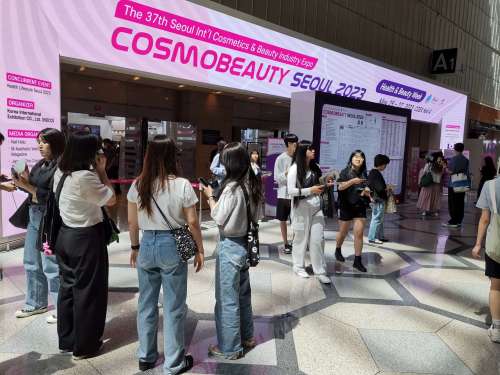
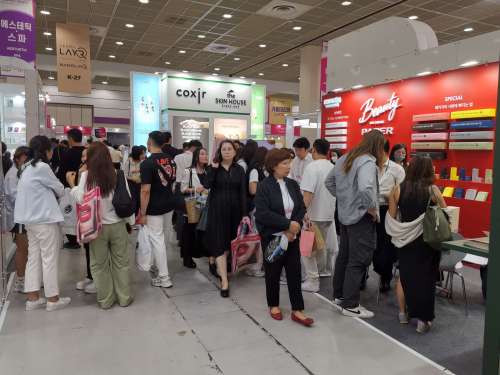
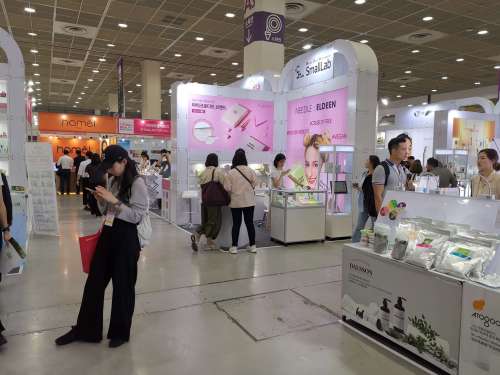
This was the second Cosmobeauty Seoul trade show after the pandemic and my first Cosmobeauty since 2019! This year’s trade fair was a good bit smaller than its pre-pandemic shows – just one hall in COEX expo centre rather than the customary two halls – but I had kind of expected this: Every beauty trade fair that I visited over the last eight months (Cosmoprof Asia 2022, Cosme Tokyo 2023, Vivaness 2023, Cosmoprof Bologna 2023, Beauty Düsseldorf 2023, Beautyworld Japan 2023) has been smaller than its respective pre-pandemic iterations. You can check out my previous Cosmobeauty coverage here: Cosmobeauty Seoul 2016, Cosmobeauty Seoul 2017, Cosmobeauty Seoul 2018 and Cosmobeauty Seoul 2019.
What kinda DID surprise me were the great many international (Western) visitors at Cosmobeauty Seoul this year! There were definitely more Caucasian faces around than during the 2019 show. And when I think back to my first Cosmobeautys in 2016 and 2017 – wow. Back then there were maybe half a dozen Caucasians amongst the visitors. This year, Westerners alone accounted for at least a quarter of all attendees, I think.
COSMOBEAUTY SEOUL 2023: MAJOR TRENDS
In terms of key product/brand trends, “vegan” – frequently combined with “clean” – was by far the most visible brand claim at the show, especially amongst the new GenZ beauty brands. And oh, there were so many of them : )
Most of these new brands also had a strong gender-free, eco/green (=greenwashed) and minimalistic angle (like you would expect from a GenZ positioned brand) and, interestingly enough, there were even a couple of brands exploring upcycled ingredients and plant conservation/biodiversity. However, “organic” and “natural” weren’t really that present at the show this year – and I seem to remember that these were much more prominent claims at the pre-pandemic Cosmobeauty trade fairs.
As a quick note: I can’t read Korean but of course I notice the English-language marketing terms used in the Korean-language marketing visuals and on the packaging. Most new GenZ brands made sure to reinforce their clean/vegan credentials by using the English words in their marketing material.
I guess vegan/clean is trumping “organic” in Korea just as it does in so many other country markets. It kind of fits in with what I’ve seen in-store here in Seoul: There are prominent clean beauty store sections at Olive Young (drugstore chain) and Chicor (perfumery) while organic/natural has all but disappeared from the shelves.
Plant ingredients were ubiquitous at the trade fair; both in the hanbang (traditional/medicinal plant extracts) and mainstream (yuja fruit, I’m looking at you!) sense. Quite a few of the new indies use plant extracts (hydrosols/distillates) as an actual product base rather than just including a random herbal extract in the INCI and calling it a day, which is something I really like.
The global microbiome trend was also very VERY visible at Cosmobeauty Seoul 2023, both amongst the new GenZ brands and established/older Korean labels – “barrier care”, “barrier cream”, “biome care” was everywhere. And, of course, Cosmobeauty Seoul 2023 also featured all the high-tech (and non-vegan) anti-ageing beauty launches you’d expect at a Korean beauty trade show, starfish collagen and umbilical cord blood stem cells over at-home fractional laser devices to functional beauty galore. Rather exciting : )
COSMOBEAUTY SEOUL 2023: PLANT-BASED AND ECO
SAPPOM (Korea)
Traditional Korean TCM/hanbang beauty brand Skylake launched a super cute new GenZ face care brand in 2021. Based on Skylake’s traditional TCM plant-infused water blend, the 7-sku Sappom range also features apple extract and was introduced to reach a new consumer demographic. The original Skylake range (of which I am a fan) does look a bit retro admittedly, but Sappom is really nailing it with trendy pouch packaging for its smaller-sized products and colourful pack design visuals.
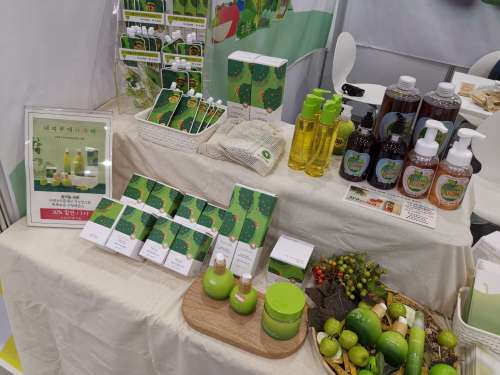
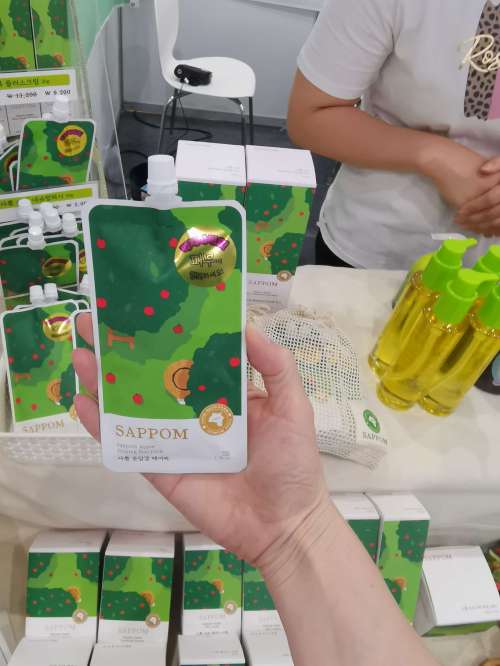
I bought several small Sappom sizes to try them out and you can tell the proprietary Skylake herbal complex; the products smell very similar to most of Skylake’s face care products. Sappom is almost exclusively sold online at the moment – like so many new indie brands in Korea these days – as Skylake’s Insadong retail store had to close down during the pandemic. Products are priced from 20,000-30,000 KRW (around 14-20 Euro).
PRETTY ACTUALLY (Korea)
A recently-launched GenZ-positioned brand with an upcycling slant, Pretty Actually offers two product ranges – the 4-sku Peach and a 2-sku Goji range, with a third line (Broccoli) coming in July.
Upcycled beauty ingredients (which usually refer to ingredients manufactured from food-waste or other by-products of commercial food or beverage production) are a major trend in Europe right now but I haven’t really seen many Asian brands active in this space. Or at least none that used the upcycling angle as a key marketing claim.
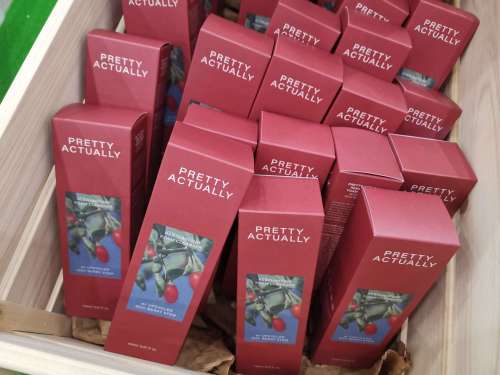
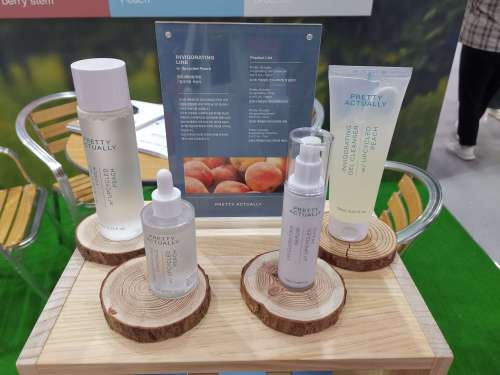
The INCI listings of the Pretty Actually products are mostly conventional so there’s not a lot of excitement there, but the products look and feel pretty good. They’re also vegan, gender-free and so on, so should do well with their intended demographic : )
DEARDOT (Korea)
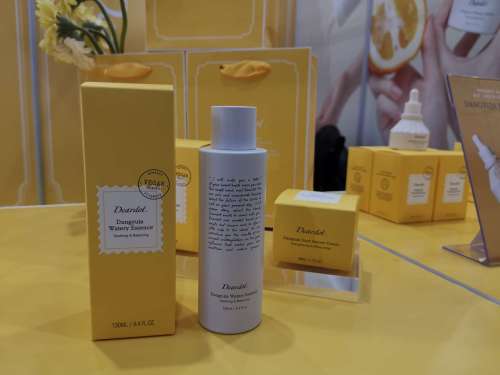
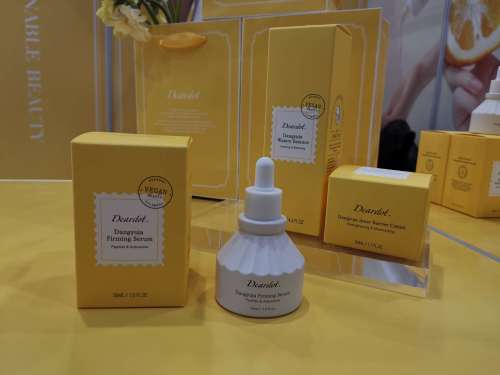
Another eco-positioned beauty brand, but with a focus on biodiversity which I thought was really interesting. Deardot was launched in October 2022 and the star ingredient in its five vegan beauty products is the citrus-pomelo hybrid dangjuya which grows only in Jeju island.
Because the dangjyua doesn’t taste well it is no longer grown commercially which means that the plant – like so many old or unpopular fruit and vegetable varieties – is already on the endangered plant list. Deardot decided to make the dangjuya fruit into a cosmetic active (the dangyua is a traditional medicinal plant in Korea and contains around three times as much vitamin C as lemons) and use it in its beauty range, thus hopefully preventing the dangjuya plant from going extinct. And here is what I think is really cool: The company donated dangjuya seed to the Baekdudaegan Arboretum’s Seed Vault in Bongwha region.
This seed vault is a bit different from other seed libraries across the world: The Bongwha Seed Vault (which is in a high security, earthquake-safe location and holds around 100,000 seeds from some 5,000 different wild plant species already) is one of just two seed vaults in the world that collects wild plant seeds to keep them safe in the case of an apocalytic event like nuclear strike, war, natural desaster climate change.
If you’re interested, the other doomsday seed vault is located in the Arctic, on Spitzbergen. Svalbard Global Seed Vault is a global repository of food crop seeds and plants, with seed donations from over 100 countries worldwide. It has the same brief as the Bongwha vault: Keep the seeds safe in case things end badly.
But to return to Deardot: The products looks really nice, they all contains dangjuya ferment filtrate (the watery essence is based on over 90% of the filtrate), textures are great and the packaging is pretty. At the moment, products are mostly sold online but eventually the company want to open its own retail stores. I’ll keep my fingers crossed for them!
GINGER6 (Korea)
This rather interesting k-beauty brand was launched in 2020 (I probably don’t need to mention that this is also a gender-free and vegan GenZ offering?). The Ginger6 line-up includes six face care products and here is what I like about it: All products are based on ginger water, not purified water.
These days I find myself preferring face care brands that include as many hydrating ingredients as possible, and I would almost always rather buy a face care product that is based on a hydrosol or other plant water than purified water. Especially if the plant extracts are fairly low on the INCI list.
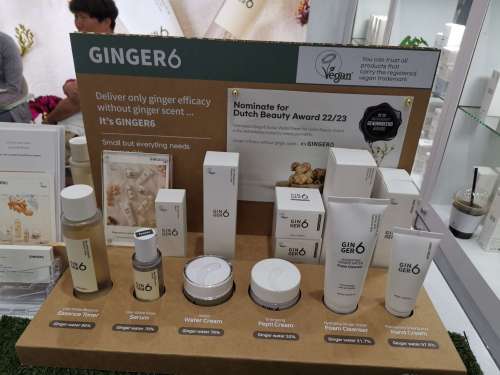
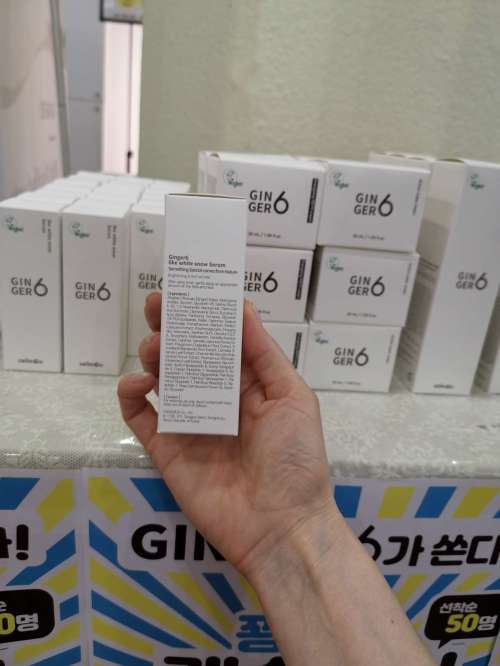
Anyway, the Ginger6 products list ginger water as the first ingredient, carefully treated to remove the fragrance molecules. Personally, I love the smell of ginger but the brand says that many customers don’t like ginger scent so they decided to deodorise the ginger water by alternately steaming and drying the ginger six times over the course of 10 days to increase the potency of its skin care compounds whilst slowly decreasing the gingerol (which is the substance that gives ginger its spicy smell and taste).
The Ginger6 range comprises an essence toner, a serum, a water cream, hand cream, peptide cream and, as the latest product, a foam cleanser.
MAROHAN (Korea)
Marohan is a beauty brand from Jeju so most of their product ranges are based on camellia as key ingredient.
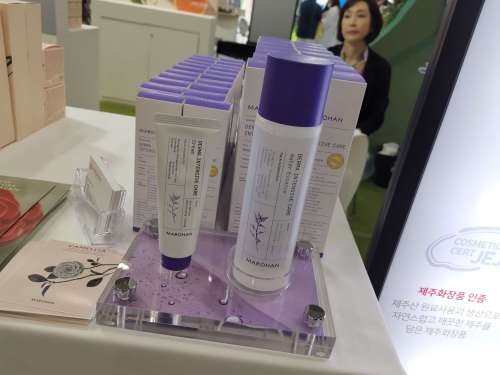
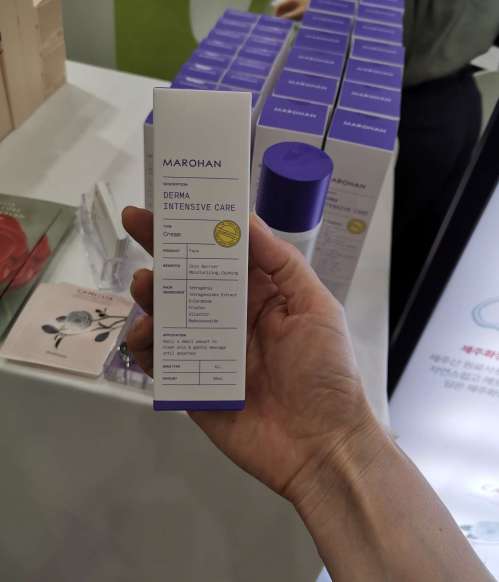
However, the brand’s new Derma Intensive Care duo of serum and cream is rather interesting: This is full-on barrier care formulated with ceramides and soothing madecassoide to calm and regenerate a damaged skin barrier.
FARMSTAY (Korea)
I see Farmstay at pretty much every trade show I’ve been to and always like checking out their new launches. At Cosmobeauty Seoul 2023, the brand presented its new Citrus Yuja range which was launched earlier this year.
Yuja is a Korean citrus fruit (usually grown on the island of Jeju) which is super mega popular as a flavour, fragrance and cosmetic ingredient. Seriously, almost every k-beauty brand that has more than a few product ranges will have at least one yuja-based range. Starbucks Korea has several iced summer drinks that feature yuja, there are yuja sweets and yuja beverages – the fruit really is ubiquitous. Like the yuzu fruit in Japan.
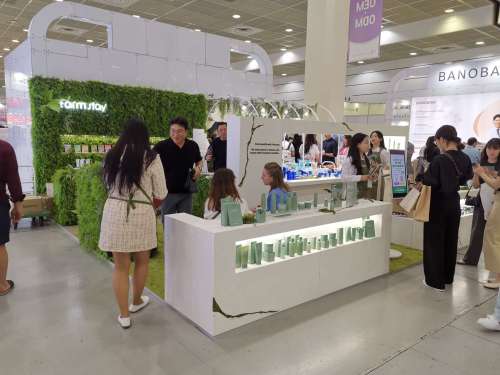
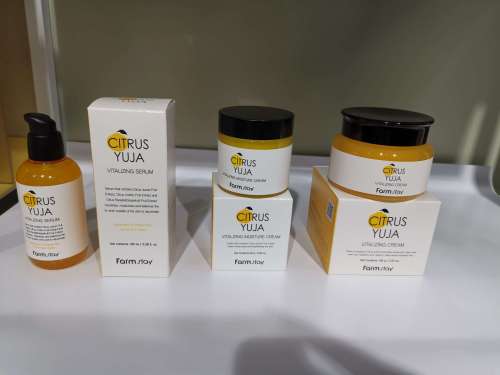
Anyway, there are 11 sku in the new Citrus Yuja range, primarily face care, and the fragrance is,of course, divine – citrus, grapefruit, juicy yuzu.
COSMOBEAUTY SEOUL 2023: GENZ, VEGAN AND GENDERFREE
DISCLAIMER: I didn’t see a single new GenZ beauty brand at the show that wasn’t also vegan, and the majority of brand launches also had a distinct gender-free angle going on in terms of packaging and positioning. It is definitely a MZ thing (MZ: Korean market research term for the group including millennials and GenZ) and has a strong lifestyle component. Basically, you can just assume that any GenZ-positioned beauty brand launched within the past couple of years is also vegan : )
HAMÉL (Korea)
Launched in 2022, Hamél is a vegan makeup and skin care range. The brand name combines the initials of the words Habit Me Love (the habit of loving myself) and the brand concept is much like you’d expect: GenZ demographic, natural ingredients, living in harmony with nature and so on; the product formulae are, well, clean beauty at best.
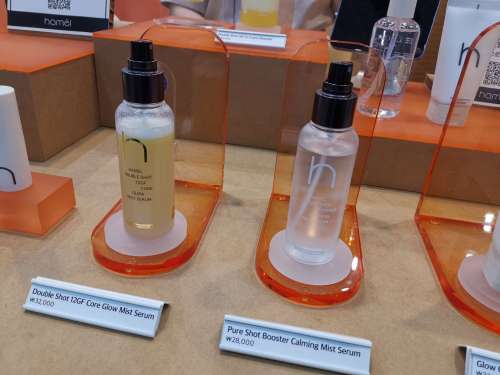
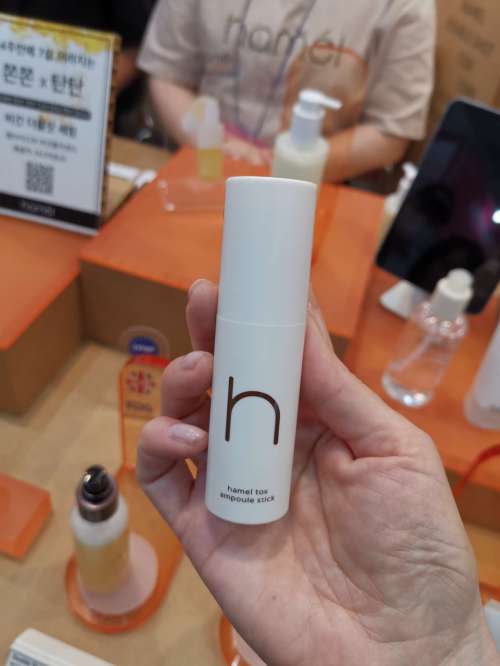
The vegan claim is heavily emphasied (as with most recently launched GenZ-positioned k-beauty); the packaging is stylish and the line-up is divided into three sub-ranges: barrier care (toner, lotion and serum formulated with ingredients to boost the skin barrier), anti-ageing (serum and multibalm) and sun care (SPF serum and SPF cream), plus an oil to foam cleanser and an SPF cushion compact – trending product textures and ingredients; this brand is really on point with its brand positioning. Hamél is sold online and in Lotte Duty Free in Myeungdong.
AROUTINE (Korea)
More gender-neutral beauty: The 5-sku Aroutine face care range is also vegan (of course!) and was lauched in 2021. Product formulae are mostly conventional (albeit with a clean slant) and the packaging is rather pretty. The brand’s newest product is the White Rose & Vitamin 10 Ampoule sheet mask.
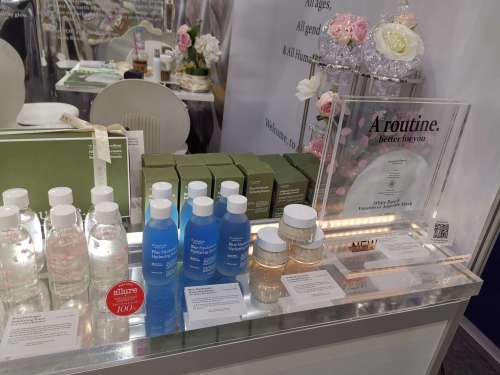
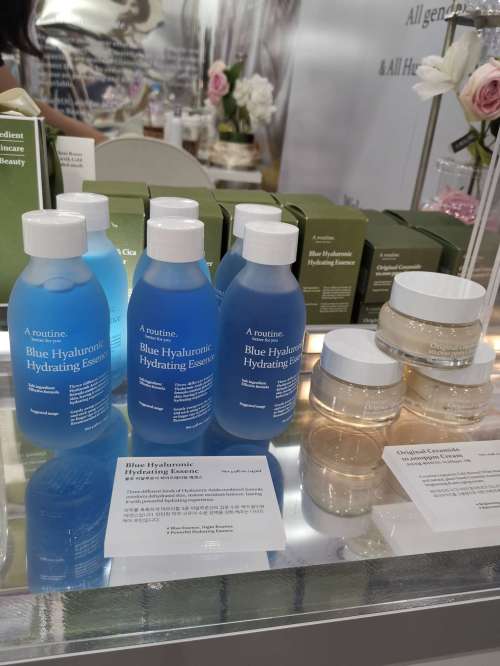
Considering that the brand was launched just a couple of years ago they have already achieved a pretty solid distribution that isn’t just online: In Korea, the Aroutine products are also sold in Shilla Duty Free, Lotte department stores and indie retail (fashion stores, concept stores).
CLAPS (Korea)
Gender-free, vegan beauty again: The 4-sku Claps range was launched a few months ago and focuses on skin barrier health. The line-up offers a two-phase toner, two ampoules and a cream.
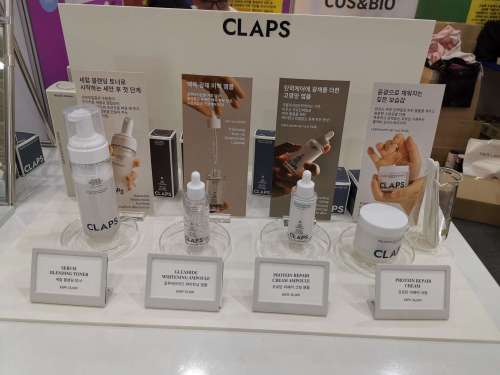
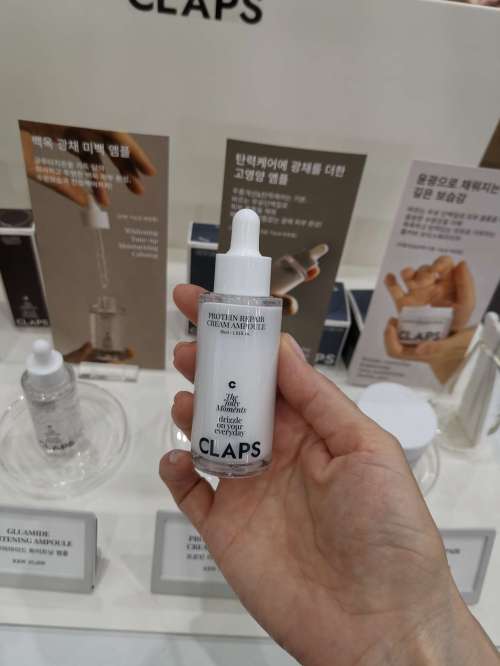
I quite liked the texture of the Serum Blending Toner which you shake before use so it becomes soft and creamy. The product formulae are quite unexciting otherwise. The Claps products are sold online retail only and carry a price tag of 24-30 Euro.
SIMPLICA (Korea)
Described as conscious, clean and vegan beauty, Simplica was launched in 2020 and offers five serums (including a tinted version) and a cleansing gel.
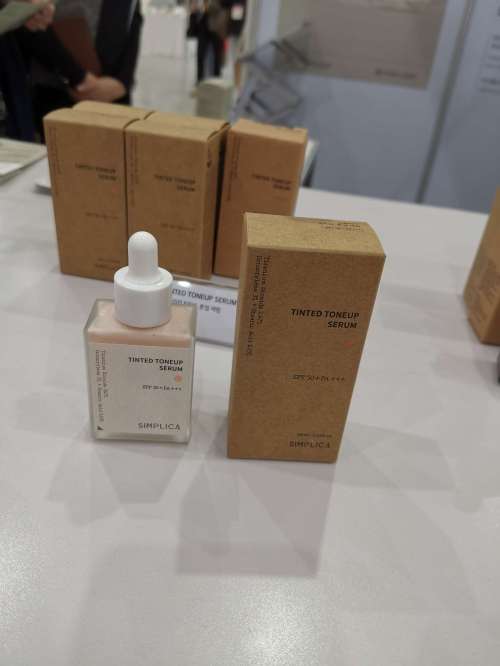
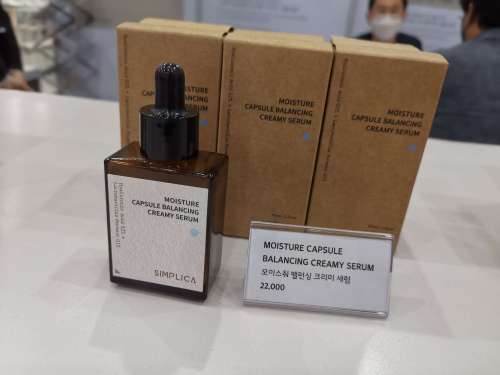
The apothecary-style packaging is really stylish, the formulations, unfortunately are hard-core conventional and not particularly exciting. Still, the brand vibe should absolutely appeal to MZ customers.
DOCTOB (Korea)
This is yet another vegan microbiome-focused face and body care range. Doctob was launched in 2022 and most of the brand‘s face care products are based on plant extracts.
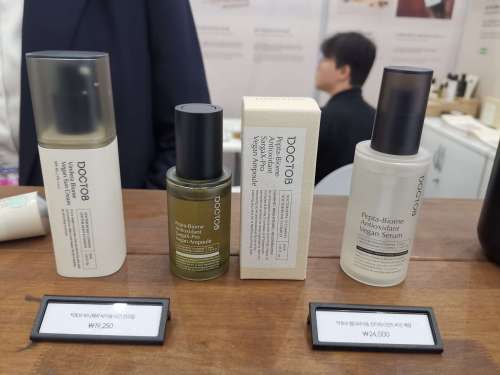
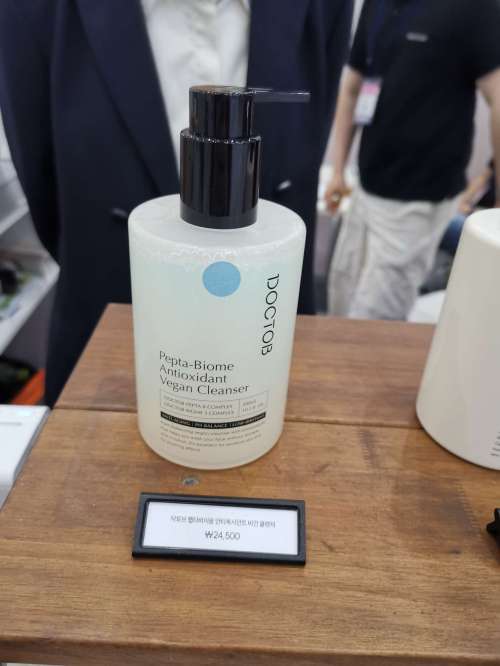
The line-up includes a cleanser, toner, cream, sheet mask, serum, sun cream, ampoule and body lotion, hand wash and hand cream. The Doctob products are sold online and offline in Shilla Duty Free and Hyundai department stores.
AGE ZERO (Korea)
Korean beauty powerhouse brand Fascy recently launched a new range for older consumers: Age Zero is vegan anti-ageing face care range launched for customers aged 40+.
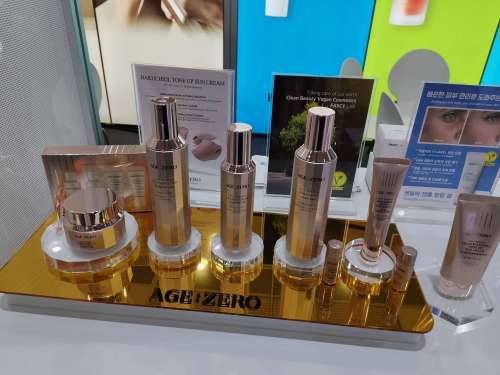
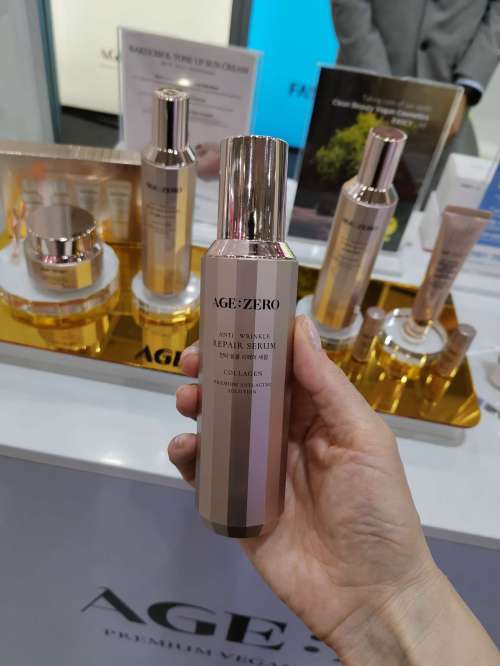
The 6-sku line-up includes a toner, serum, emulsion, eye cream, rich cream and hybrid sun cream; and the key active in all products is bakuchiol. The packaging is the slightly over-the-top metallic luxury face care pack design popular amongst many of the older Korean beauty brands.
In Korea, Age Zero is sold mostly in offline duty free shops and of course online. I was told that the brand is also trying to expand into the US market through Amazon.
COSMOBEAUTY SEOUL 2023: HIGH-TECH FACE CARE
Face care is always a really exciting category at any predominantly Asian trade show because most of the major ingredients and beauty tech innovations seem to originate in this region. And of course Korean brands are always in the lead, presenting the latest in high-tech beauty.
PURAXEL (Korea)
In late 2022, beauty tech brand Puraxel launched an at-home laser skin and scalp care device. The company already offers a more professional model for salon use and says that it’s Puraxel.me tool is the first laser home care use.
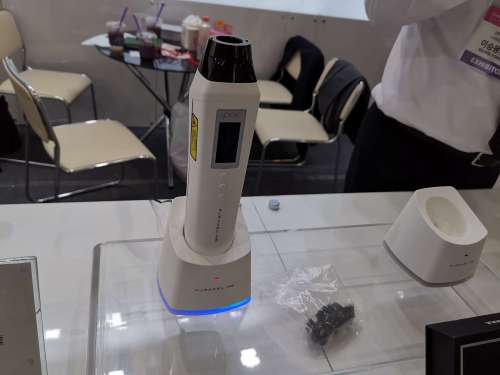
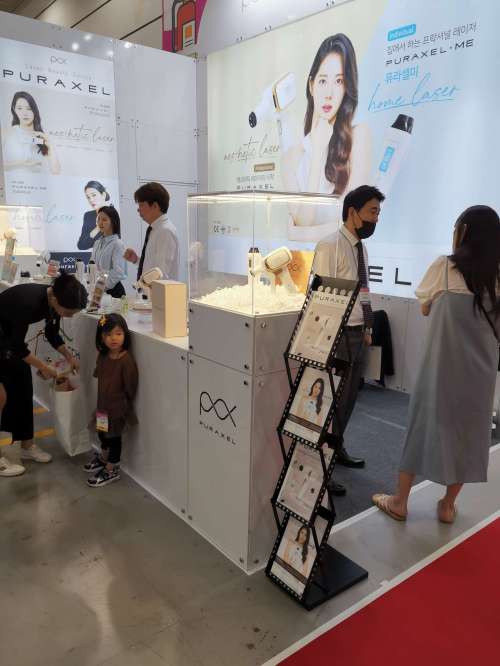
Puraxel. me is a fractional laser device with differently shaped applicator tips for different areas of the face and scalp. First you position the black applicator tip on the skin/scalp area you want to target and press the button. The tool pierces 100 micro pores with a depth of 200μm (micrometers) per „shot“ into the epidermal layer and will prepare the skin to better absorb the active ingredients contained in the beauty products.
After this preparation step you apply your essence, ampoule or whatever, switch the device to the silver cap and press it onto the skin again to massage the products into the skin. I tried out the the laser device on the back of my hand and didn’t feel a thing.
RECLAR (Korea)
Reclar is a salon beauty brand and at the trade show they presented their biggest beautytech gadget, a face massager/scraper with a (to my eyes) unusual approach. You’ve seen the usual kind of face massagers, with blue and red LEDS and various radio/EMS/vibration frequency settings.
The Reclar device looks like something you use to scrape down surfaces in a kitchen, it has a kind of flat blade as an applicator. And yes, there are three settings but these adjust the type of vibration according to what product you use the device with.
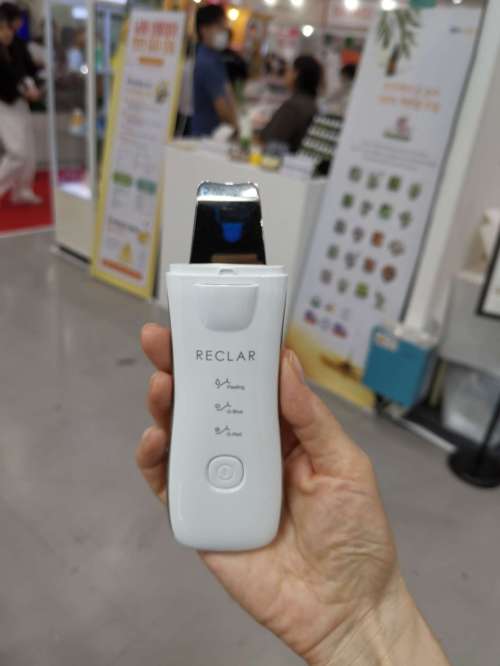
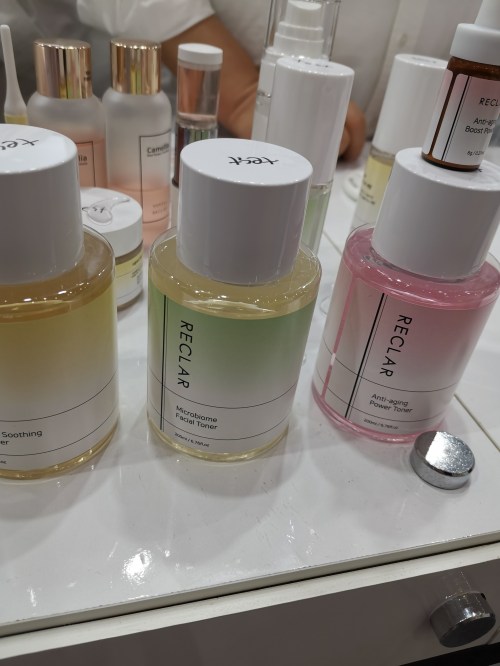
The „peeling“ setting is used first to prepare the skin. Place the „blade“ at an angle to the skin and gently push it along the skin to „scrape“ off the skin. Then you apply your serum or essence onto the blade, select G-Blue (for liquid and semi-liquid products) or G-Red (for creamier/heavier products) and push the blade along the skin again. The vibration changes according to the setting and the products are kindo of vibrated into the skin.
Earlier this year, Reclar launched a consumer home-care beauty range. As you would expect from a salon beauty brand, the new line is heavily functional, focusing on specific actives and skin situations. There are three sub-ranges: Calming & Soothing with 4 sku, Microbiome (3-sku) and Anti-Ageing (2 sku). See pic above.
PENELLAGEN (Korea)
This is a active complex rather than a brand name but Penellagen plays the lead role in two beauty brands launched by Stars Tech, so it gets its own entry! The two brands are Rerave, a teleshopping-exclusive brand, and anti-ageing range Labope which is sold online and offline in Hyundai department stores (I actually saw Labope in the B Clean at The Hyundai a few days ago).
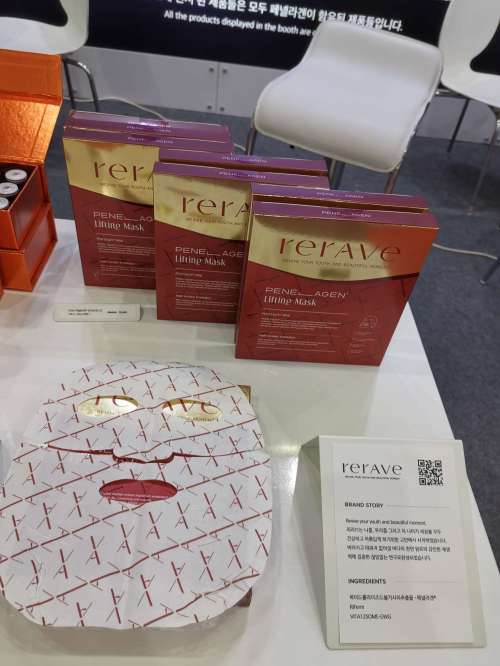
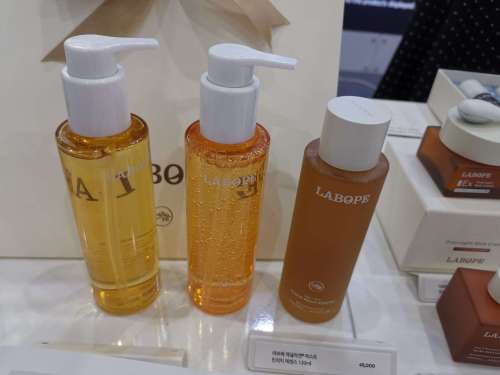
Penellagen is described as the first collagen to actually penetrate into the epidermal layer of the skin. It’s a trademarked complex which promises to deliver the active deep into the skin courtesy of a specific TDS (an elastic ethosome derived from double-layer phospholipids). The collagen molecules are starfish collagen peptides which are said to have a brightening effect on the skin, prevent wrinkles and won’t irritate the skin.
ROOICELL (Korea)
Korean salon/professional beauty manufacturer Rooicell’s latest launch has a pretty unusual key active (unusual for the European beauty industry anyway): Human stem cells derived from umbilical cord blood. Now, human stem cells are a very popular cosmetic ingredient in several Asian markets (especially in Japan; Cosme Tokyo usually has at least half a dozen human stem cell tech exhibitors). I think Rooicell might have been the only exhibitor at Cosmobeauty Seoul this year with human stem cell beauty and they advertised this fact in English so I went over directly.
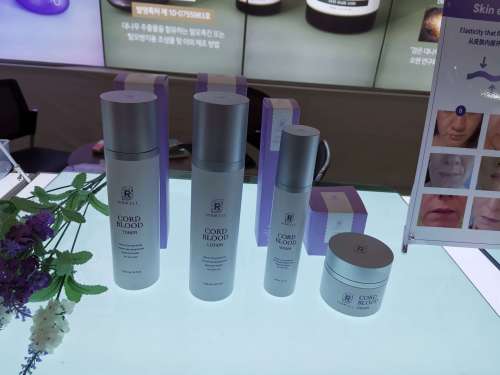
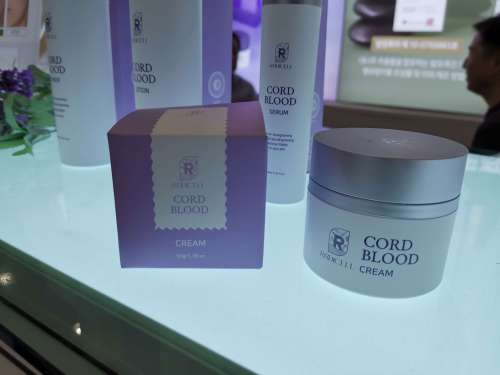
Stem cells derived from umbilical blood are said to be especially pure and potent. The Cord Blood range comprises four face care products – toner, serum, lotion and cream – and was launched just a few weeks ago. Pricing and distribution is yet to be determined but both will be in the luxe/premium category.
At the moment, Rooicell is focusing on its marketing activities in Korea and China but I was told that the company has already begun the process to get Cord Blood its European CPNP registration. I really need to do some research into whether human stem cells (or stem cell tech in general) as a cosmetic active is a thing in Europe (I suspect it might not be).
KOCOSTAR (Korea)
The big Kocostar launch at this year’s Cosmobeauty Seoul trade show was the Yellow Cream Patch, an anti-blemish treatment described as a liquid cellulose seal inspired by ODT (occlusive dressing technique). The patch kit also contains sterile cotton swabs for application.
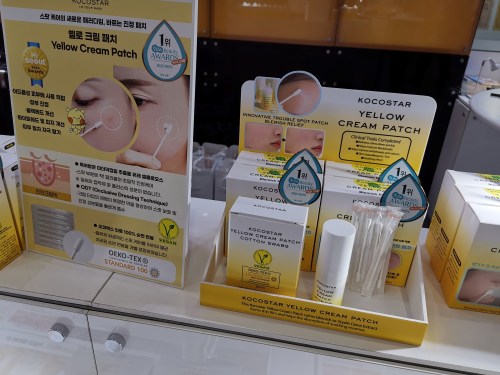
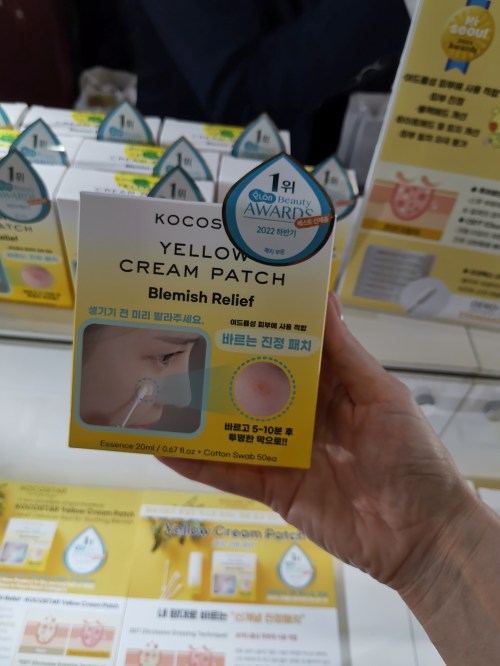
The anti-blemish liquid contains natural cellulose which forms a barely visible protective film on the skin, keeping the anti-blemish actives (sulphur, salicylic acid, tea tree leaf extract) on the skin and speeding up healing.
Kocostar says that the Yellow Cream Patch adheres better to the skin than regular pimple patches and because the film is barely visible, it is easy to apply makeup on top of it. You can also cover different sizes of impurities and larger areas on the skin.
BANOBAGI (Korea)
Banobagi is another very well known Korean beauty brand with a solid domestic and international retail presence. The company‘s newest launch is a duo range of serum and tone-up cream (a very lightly tinted moisturiser) formulated with alpha-arbutin.
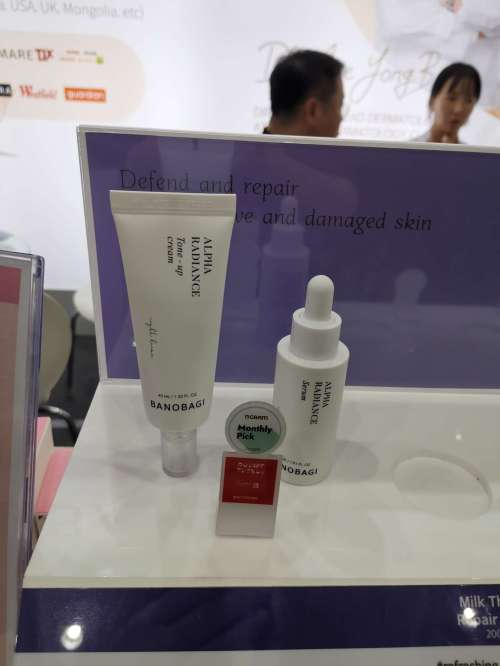
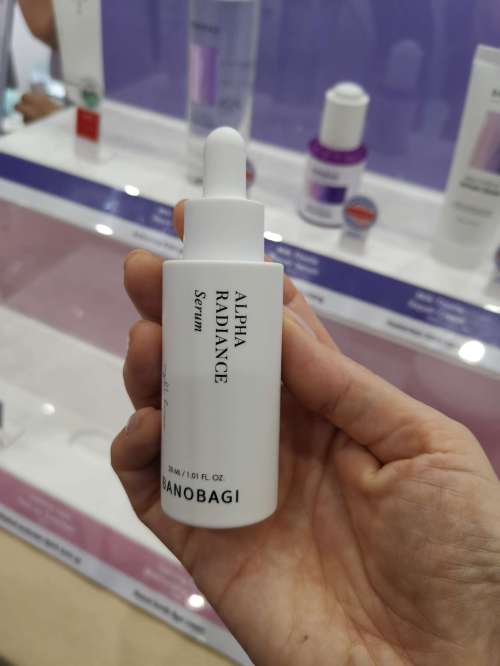
The products look interesting though – I’ve never actually tried out anything from Banobagi but I kind of liked the look of the alpha-arbutin duo.
ELDEEN (Korea)
The name of this Korean brand is „needle“ spelled backwards and that it exactly what Eldeen offers: self-dissolving microneedle beauty. Launched in 2022, Eldeen’s product range include differently-shaped microneedle patches, including round shapes for specific skin areas and comma-shaped undereye patches.
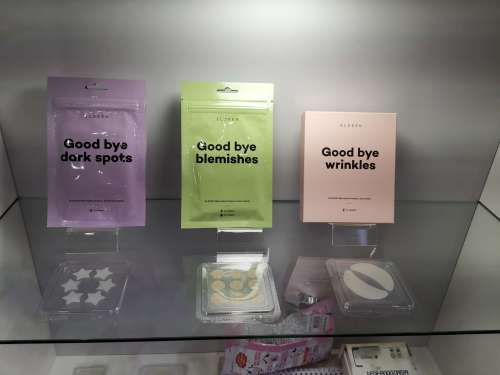
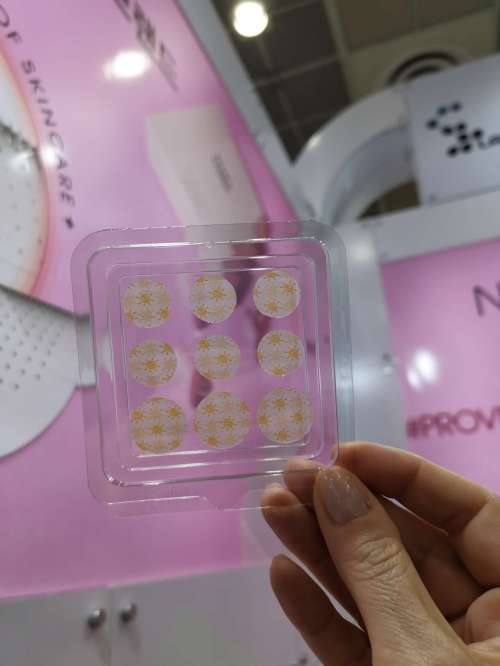
As is usual with self-dissolving microneedle products, the active ingredients are shaped into tiny spikes and dissolve once the patches are pushed onto the skin and (very lightly) perforate the top-most skin layer.
LALARECIPE (Korea)
OK, admittedly pimple patches aren’t really high tech but I’m sticking Korean GenZ brand Lalarecipe’s new star-shaped anti-pimple patches into this category because they are just so pretty.
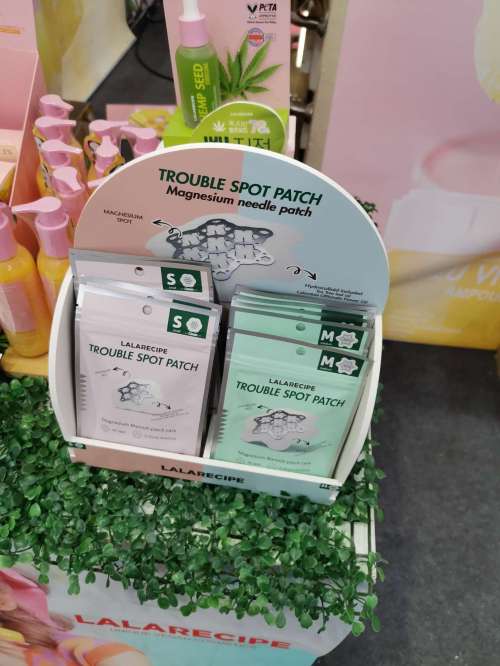
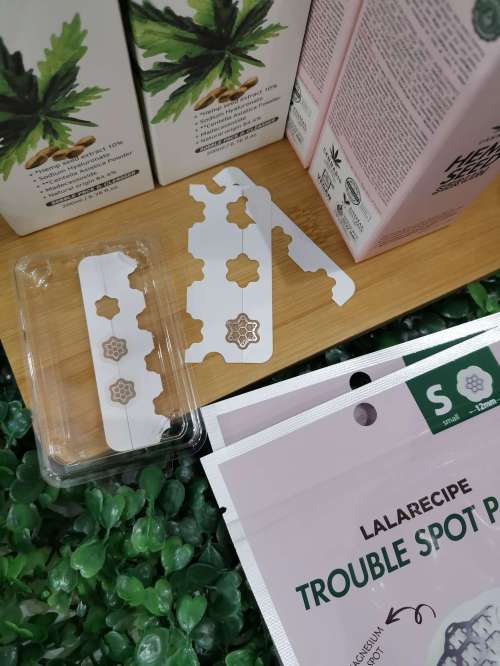
The patches are based on magnesium powder and magnesium oxide with tea tree and calendula oils and a pack contains ten pimple patches. These are self-dissolving microneedle patches which you press onto the skin so the active ingredients spikes pierce the skin. Lalarecipe offer two different patch sizes, small and medium.
AWY (Korea)
Salon beauty brand Awy’s (the brand name is short for “Always with You”) latest launches include two really nice looking functional serums, Vitamin Tree Serum and Collagen Lifting Serum.
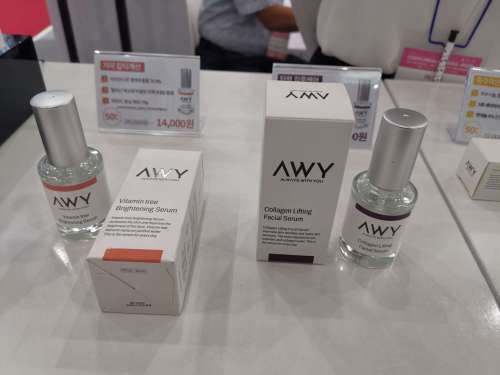
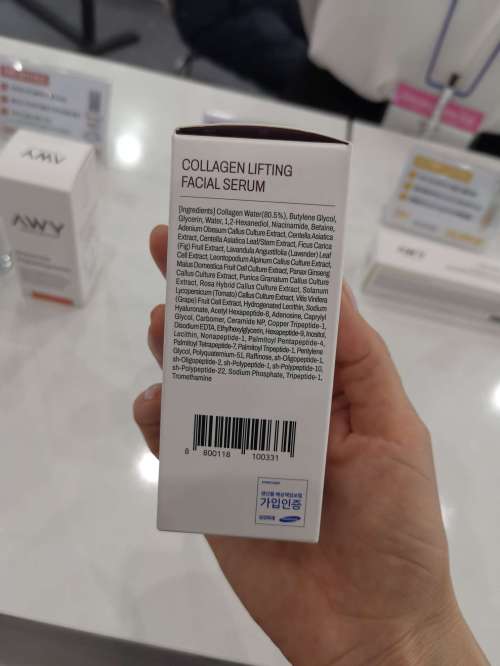
The INCI listings are great, packed with plant extracts and actives and based on hydrosols or, in the case of the Lifting serum, on 80.5% collagen water. I bought the Collagen Lifting Serum because the ingredients looked so interesting (a ton of peptides and plant extracts) and was so pleased with the product performance that I purchased a second bottle on the last day of the trade show.
ISOV (Korea)
Isov is another salon brand focusing on dermoceutical and functional cosmetics. Their fragrance-free 7-sku serum range was launched in April 2022 and is formulated with HD Ethosome, a double-layer phospholipid acting as a special delivery system for the active ingredients.
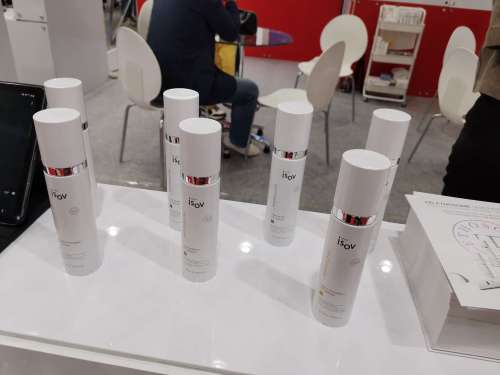
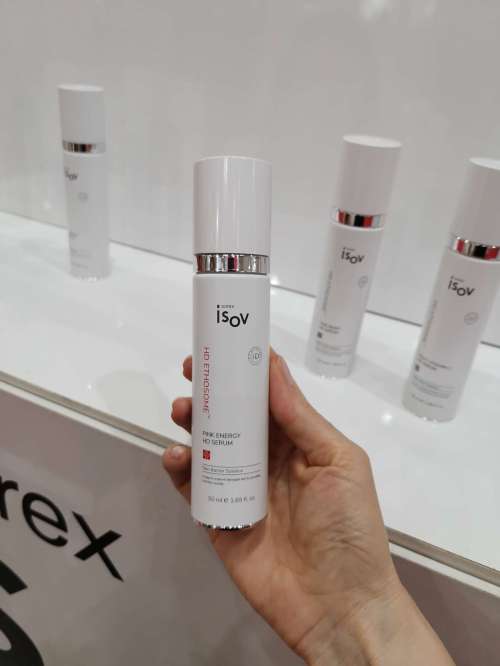
The serums are said to offer the effect of a needle-injected salon treatment but without needles, and the line-up includes Skin Boosting ACT Serum, Blue Energy HD Serum, Time Reset HD Serum, Multi Vitamin B HD Serum, Skin Brightening ACT Serum, Pink Energy HD Serum and Multivitamin C HD Serum.
COSMOBEAUTY SEOUL 2023: FUN BRANDS
This is where I’ve collected all of the beauty brands that I liked but that didn’t really fit into any of the other categories. And, after all, using cosmetics is not just about the physiological effects or making the world a better place but something that can (and should) be enjoyed as well!
NACIFIC (Korea)
And face and body care brand Nacific presented a really fun new launch: A limited edition collection of the brand’s vegan hand butter in collaboration with Nacific’s male k-pop brand ambassadors Stray Kids. The Hand Butter set contains eight individually packaged small tubes of hand creams.
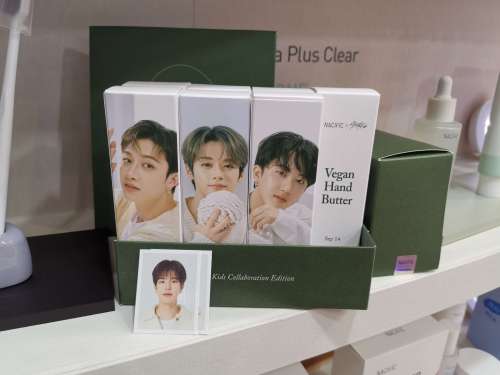
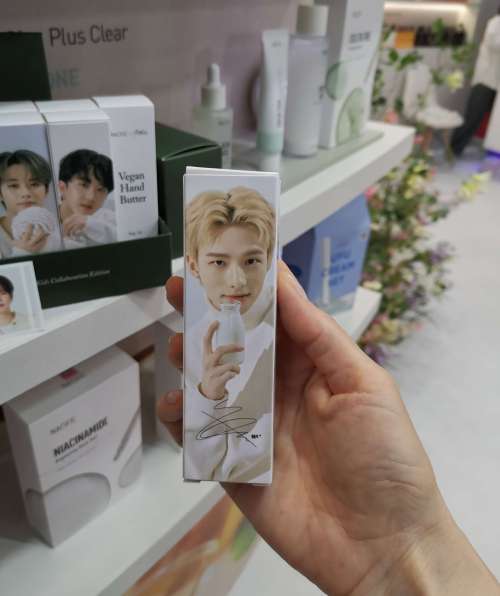
Each individual pack is dedicated to a member of the Stray Kids: The cardboard pack features the respective singer’s portrait, the tube is marked with the singer’s birth date. Each tube is further personalised with a hand-written message of the band members, I can’t read Korean but was told it usually says something like: take care and moisture, self-care is important – that sort of thing. The box set also includes a small envelope with passport photo–type images of the eight band members.
The set was launched a couple of months ago across all of Nacific’s international markets and sold out almost immediately, generating turnover of over 1 million USD in three (!) days. The hand butter set sold especially well in Japan, I was told, which doesn’t really surprise me – k-pop and k-culture has been growing strongly in Japan over the last few years. K-beauty has really taken over the shelves of Japanese drugstores and during my recent trip to Tokyo, I noticed a lot of Korean-inspired dishes in the convenience stores, too.
COSBALL (Korea)
A super fun new face care range in which the products are packaged in single-dose plastic balls. Cosball offers 12 sku of essences, ampoules, lotions etc., each product is packaged in a different colour and glass jar.
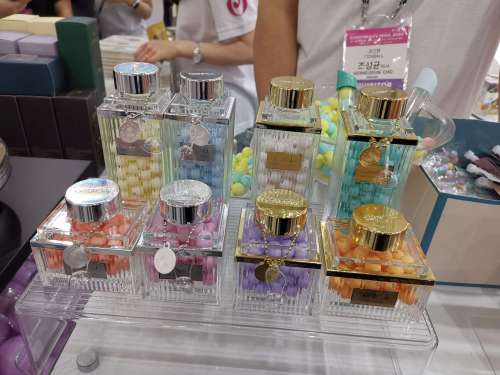
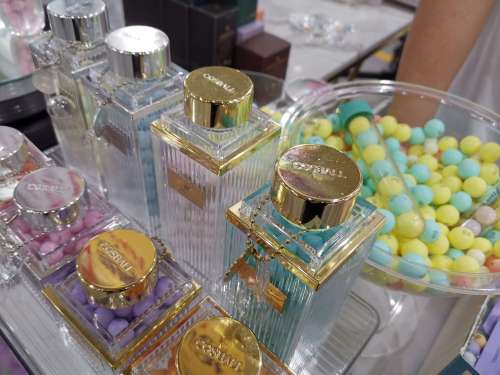
According to the Google Translation of the brand’s brochure, the product formulae are based on a herbal water infusion instead of purified water (this also has a preservative effect) and include a high percentage of active ingredients. The material of the balls is supposedly biodegradable (says the Google Lens) but I was unable to verify exactly what kind of material is used to manufacture the ball packaging.
You open the balls by pulling off a tiny sticker or pierce the skin with the little opening device attached to the neck of each jar. There is also baby care (green, yellow and blue) which are packaged in larger spheres. Cosball says that its individually packaged skin care balls are much better than creams and lotions in jars because they are more hygienic and will resist contamination longer. The brand was launched in September 2022 and is sold online and offline in Korea.
PATCHHOLIC (Korea)
Patchholic’s a really cute GenZ beauty brand with playful packaging and trending products. Amongst the company’s newest launches are an Acocado Ceramide Moisture Cream, the Ectoin 7% Anti-Pollution Spot Pen (a twist-up anti-blemish stick) and Rose Inner Fragrance.
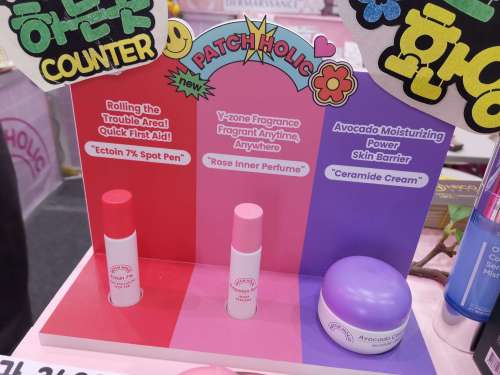
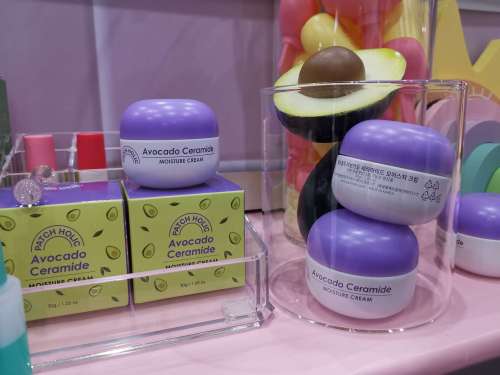
The Inner Fragrance slogan on the display case read “Y-zone fragrance, fragrant anytime, anywhere” which already gave me an indication of what this product is: An intimate fragrance spray that can also be used on other body areas : )
BARULAB (Korea)
SteamSheet Moisture Shield was Barulab’s big Cosmobeauty Seoul launch this year – a sheet mask which comes with an extra thin vinyl top mask. You apply the regular sheet mask to the face as always and then place the vinyl mask (which looks like clingfilm and is basically pure plastic) on top of the sheet mask.
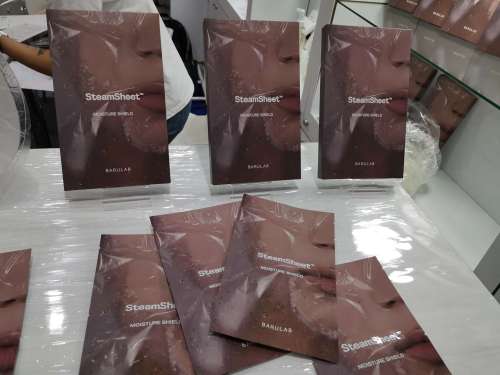
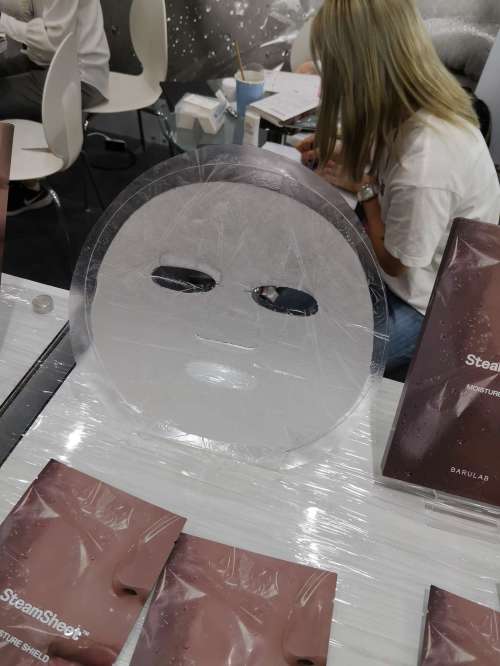
The heat generated by the plastic layer opens up the pores on the face so the active ingredients can penetrate the skin more deeply. When you peel off the mask after 20-30 minutes, Barulab says, the ensuing temperature change (skin cools down rapidly) closes the pores so the actives stay within the skin layer.
I don’t know enough about skin/derma physiology to estimate whether this is correct or not (isn’t the pore opening/closing thing a bit of a skin care myth?) but it’s definitely a great product narrative. And the Barulab booth was mobbed by visitors throughout the show so I guess I wasn’t the only one who appreciates a good story : )
LINDSAY (Korea)
Ah, Lindsay, the OG of Korean modelling masks : )
You’d think that this brand has explored every possible variation of face masks over the past decade, sheet, modelling, bubble, hydrogel, clay and so on but Lindsay’s latest launch proves that there is still room for innovation in this category.
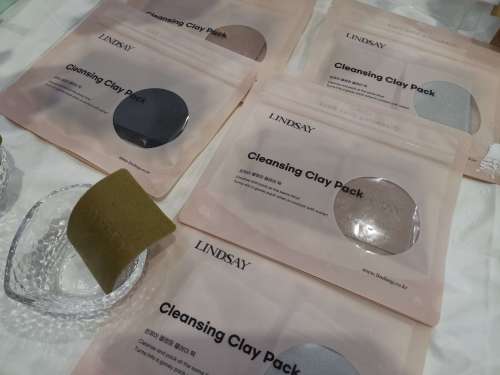
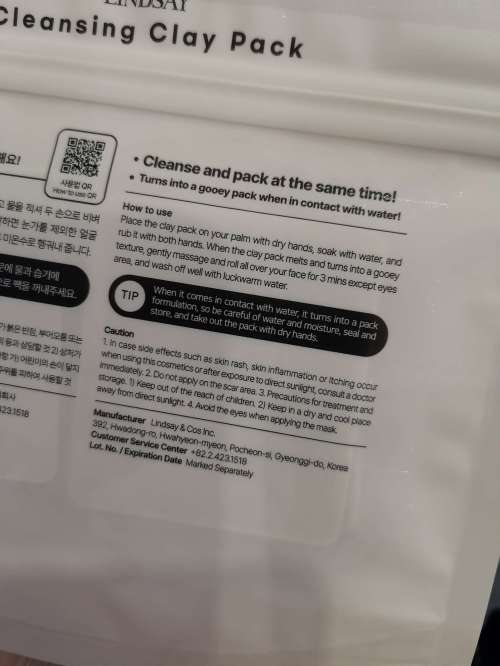
The Lindsay Cleansing Clay Pack consists of small rectangular dry pads saturated with clay. You take one of these pads, briefly submerge it in water, rub it between the palms of your hand and then wipe it onto the face – and voilá, you have a creamy clay mask without having to fuss with tubes or powders. There are five different variants and I like the convenience and travel-friendliness of this product.
MILK BAOBAB (Korea)
I just liked the packaging of this brand so much! Milk Baobab was launched in 2015 and I’m not too keen on their actual products – very highly scented bath, body and hair care products, as in really REALLY perfumed! – but the milk carton packaging and the baobab tree images just blew me away : )
Not sure why. Maybe I had a minimalistic GenZ brand packaging overload at that point or something.
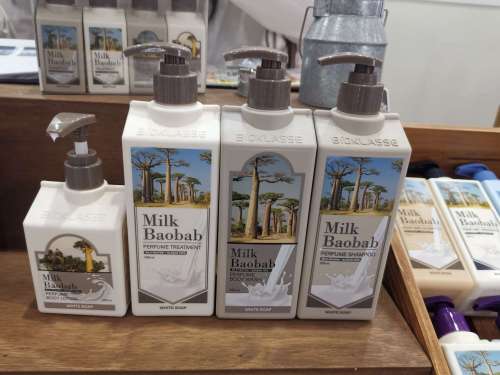
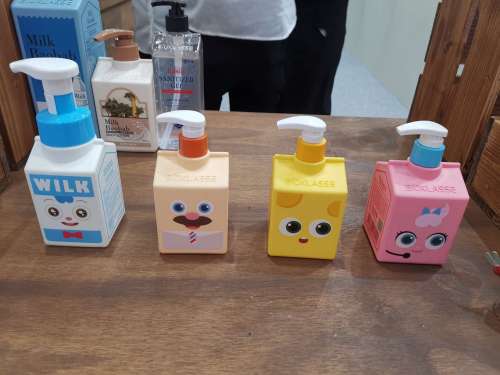
Anyway, all Milk Baobab products contain milk colostrum and baobab seed extract and the range is pretty extensive, with shampoos, body washes etc. available in different fragrances. There was also a baby care range (see pic above) with, again, such cute packaging!
SECOND SHOWER (Korea)
Bathroom aromatherapy! I thought Second Shower was rather interesting. The company’s main product are aromatherapy shower heads (showerheads with scent/aroma filter cartridges, a product type that is generally quite popular in Asia) but the brand’s latest product launches reflect the spa-at-home (or wellness, if you’d rather!) trend.
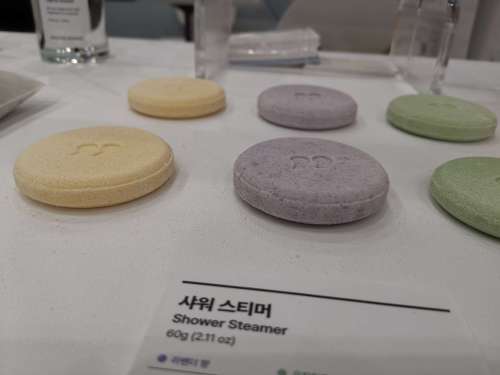
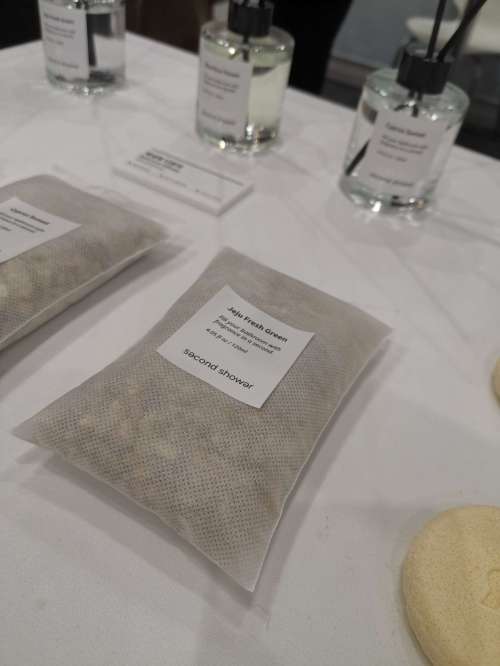
The 9-sku range offers three bathroom potpourri sachets, three shower steamers (dissolvable scented shower tablets rather like flat bathbombs which you place on the floor of the shower to release a burst of fragrance) and three fragrance diffuser sets.
And that was Cosmobeauty Seoul 2023. Thanks for reading! The 2024 show will take place from 29th to 31st May 2024

 TRENDS. TRAVELS. AND BERLIN
Pingback: Cosmobeauty Seoul 2024: [Show Report] | TRENDS. TRAVELS. AND BERLIN
Pingback: Cosmoprof Asia 2024: [Show Report] | TRENDS. TRAVELS. AND BERLIN
Pingback: Cosmobeauty Seoul 2025: [Show Report] | TRENDS. TRAVELS. AND BERLIN